
Oil, rust, leaf and algae marks, matched to the fix
Paver Stain Removal in Baymeadows, FL
Call (904) 946-8454 to ask a local contractor about the marks on your pavers.
- Brings out deeper paver color
- Fresh joint sand helps lock pavers in place
- Gives weeds less room to grow
- Makes the surface easier to keep clean
- Free estimate, no obligation
Request a Free Estimate
Free, no obligation.
Can someone remove stains from my pavers in Baymeadows, and how fast do they answer?
Paver stain removal is available in Baymeadows, FL through a local contractor, and a reply comes within 1 business day, often well before. The estimate is free and carries no obligation. To start, call (904) 946-8454.
Stains come in families, and each family has its own cure. Orange sprinkler rust, brown leaf tannin, black oil, green algae and white mineral film do not respond to the same product. A contractor who names the stain first gets better results than one who sprays everything with a single cleaner. That is why a short look comes before any price. Send photos of each mark when you request your free estimate.
Which stains show up on Baymeadows pavers most often?
Six marks cover most calls
Each has its own cause. If you cannot tell which you have, photos help when you request your free estimate.
Orange rust
Safe Touch says iron in well water and reclaimed irrigation leaves orange marks on hard surfaces, and that extra pressure makes them worse.
Brown tannin
Live oak leaves leave brown water stains on Jacksonville walks and drives, says Safe Touch. HydroSeal says old tannin may not disappear completely.
Black oil and tire marks
HydroSeal says oil needs degreasing and extraction. Safe Touch treats oil, tire marks and fertilizer burn when plain water will not move them.
Green and black growth
Paver Protections lists algae, mold and mildew as what dulls pavers. Wikipedia describes Baymeadows with wetland ponds and lakes, so damp spots are common.
White powder
Unilock says efflorescence is natural calcium salt, aesthetic and temporary. It can return as long as water keeps moving through the paver.
A cloudy film
HydroSeal says a white or hazy look on a sealed paver may be trapped moisture or a failing coat, not a stain at all.
Why is pressure the wrong fix for most paver stains?
What pressure does and does not do
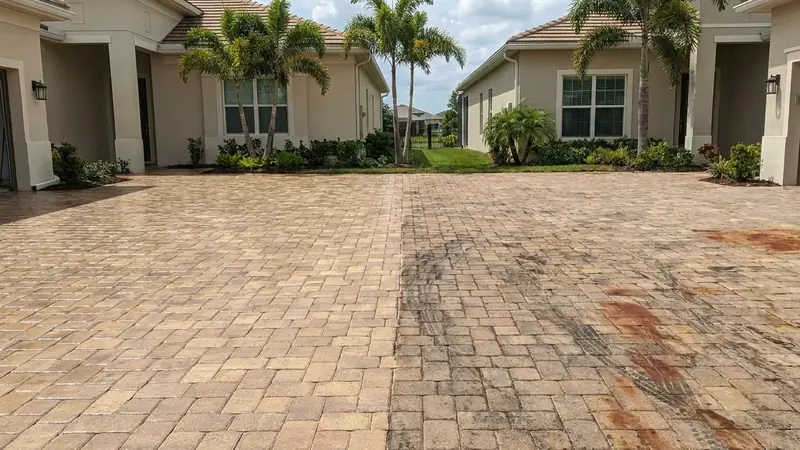
Pressure moves dirt, but it does not dissolve rust or lift oil. Safe Touch says more pressure makes irrigation rust worse. Unilock warns that heavy pressure can cut into the paver face and blow sand out of the joints. HydroSeal lists one harsh cleaner for every stain and a narrow nozzle held too close among the mistakes that cause damage. To ask how a contractor works, call (904) 946-8454.
Why acid and wire brushes need care
Acid deserves its own warning. Unilock says muriatic acid can etch concrete pavers and change their color, and should be considered only with professional guidance for mineral deposits. It also says a wire brush can leave metal fragments that rust. On stone the warning is stronger, and the travertine sealing page explains why. Ask which product is planned when you request your free estimate.
What is the process for treating each kind of stain?
HydroSeal's guide says algae, oil, rust, tannin and efflorescence each need different chemistry. The table puts that in plain words. Ask the contractor to name the product for each mark, and call (904) 946-8454 if you want to talk it through.
Mark by mark
| Mark | Usual approach | Watch for |
|---|---|---|
| Algae and mildew | A growth treatment, some waiting time, then a controlled rinse | Plants and metal nearby, and never mixing bleach with acids or ammonia |
| Oil | Degreasing, then drawing the oil out, repeated if needed | Deep oil may not fully lift |
| Rust | A rust treatment matched to the paver, then a rinse | Acids can alter concrete and stone |
| Leaf tannin | A stain treatment with time to work | Old stains may only fade |
| White mineral film | A mineral treatment after the cause is found | It can return while water keeps moving through |
Which stains come out, and which only fade?
What to expect
No honest contractor promises every mark will vanish. HydroSeal says cleaning and targeted treatment can improve many stains, but complete removal is not guaranteed and some discoloration can be permanent. Jax Exterior Cleaning says it sets expectations before it starts, and that is a good habit to ask for. A small test spot, which Unilock recommends for every product, shows what to expect. To book a look, request your free estimate.
Fresh marks and old marks
Fresh marks are easier than old ones. Oil that has soaked into porous brick or stone is hard to draw out, and old tannin may only lighten. Ask for a plain answer on your marks before the work starts, and call (904) 946-8454 with photos.
Do white deposits on pavers count as stains?
What the white powder is
They look like one, though the cause differs. Unilock says efflorescence is a powdery white deposit of natural calcium salts that does not weaken the paver. The maker calls it aesthetic and temporary, and says rain alone will not clear it. Its remover is acid-based, may shift the color slightly and should be tested in a small spot first. To have a white film identified, call (904) 946-8454.
Timing before sealing
Timing matters before sealing. Unilock says pavers must be clear of efflorescence before sealer goes on, and suggests waiting 2 to 3 months, or up to a year, if you let it fade on its own. HydroSeal adds that a white look on already sealed pavers can be trapped moisture or a failing coat, so the diagnosis comes first. Describe what you see when you request your free estimate.
What do ponds, sprinklers and shade do to Baymeadows pavers?
Ponds, shade and damp air
Water is behind most stains here. Wikipedia describes Baymeadows with wetland ponds and lakes, and says the golf course was laid out through swampy land. Safe Touch says moisture parks on north and east sides in Duval County's humid subtropical belt, and that algae takes the north wall first. A shaded patio near a pond stays damp, and damp is what algae and mildew need. To plan for yours, call (904) 946-8454.
Sprinklers, trees and pool decks
Irrigation and trees add their own marks. Jacksonville Paver Sealer says iron-rich lawn irrigation can leave orange rust on pavers, shaded patios and north-facing walls grow algae and mildew, and pool decks see pool chemicals. Safe Touch adds that oak pollen films surfaces from March into May. Tell the contractor where your sprinklers spray and which trees shade the area when you request your free estimate.
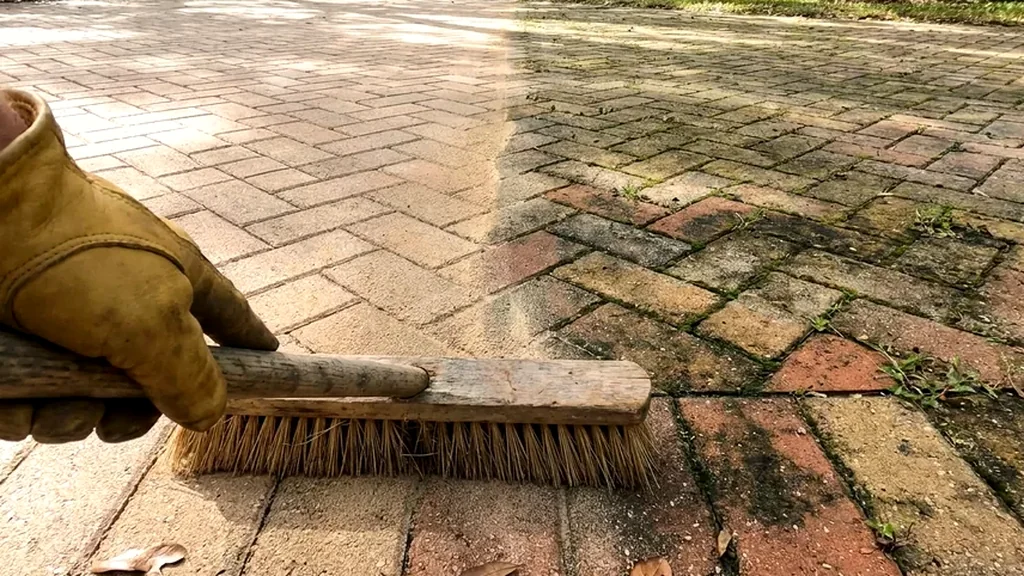
Should pavers be sealed after a stain is gone?
Sealing after the clean
Often yes, once the surface is clean and dry. Unilock says a quality sealer can resist future stains and may make washing easier, and Safe Touch says sealer on pavers keeps the next season from locking in tannin. Paver Protections says a clean surface is critical for bonding, because skipping that step can lead to early sealer failure. Ask about a coat when you request your free estimate.
If the old coat is already cloudy or peeling, read about paver restoration and resealing. If the pavers only need a wash and new joint sand, the paver cleaning page covers that. For a plain talk about which one fits, call (904) 946-8454.
What does paver stain removal cost in Baymeadows?
No company page opened for this guide prints a stain-only rate, because the work depends on the mark. Two published numbers frame it. Stallone's Pro Wash lists paver cleaning from $0.22 per square foot, and Safe Touch lists $1.75 to $3.25 to clean, sand and seal. Hydro Wash 360 says heavy algae, efflorescence and deep oil take longer and may need specialty cleaners, which a quote adds on top. To get a figure for your marks, request your free estimate.
| Area treated | Example | Wash, from $0.22 | Clean, sand and seal |
|---|---|---|---|
| 200 sq ft | Front walk and entry | $44 | $350 to $650 |
| 400 sq ft | Patio | $88 | $700 to $1,300 |
| 900 sq ft | Driveway | $198 | $1,575 to $2,925 |
The wash column multiplies each area by the $0.22 per square foot that Stallone's Pro Wash lists as its starting price for paver cleaning. The last column uses the $1.75 to $3.25 Safe Touch range. No company page opened for this guide prints a stain-only rate, so a stain treatment is quoted on top of either column.
What sends a stain job higher
Deep oil, heavy mineral film and thick algae mean longer cleaning time, according to Hydro Wash 360. The same guide says a failed coat costs $0.75 to $1.50 per square foot to strip. A starting price like $0.22 is where the range begins, not where most stain jobs end.
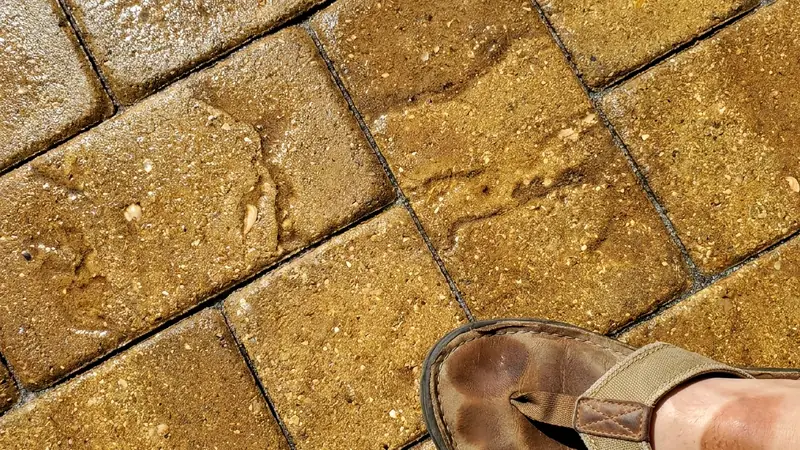
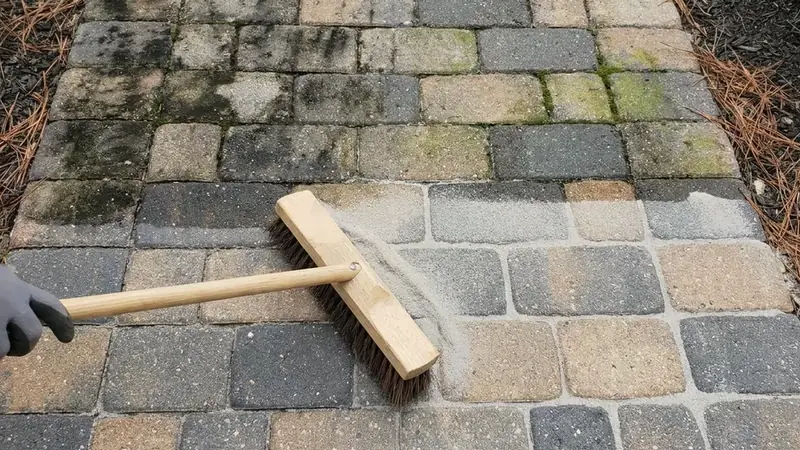
How do pavers look after stain treatment in Baymeadows?
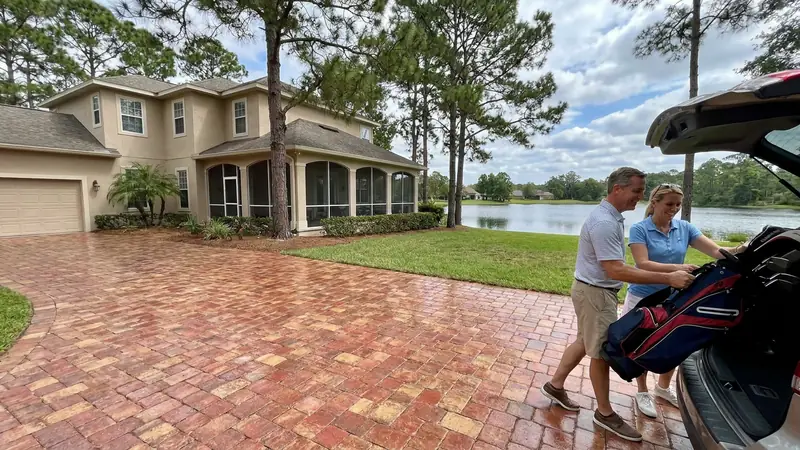
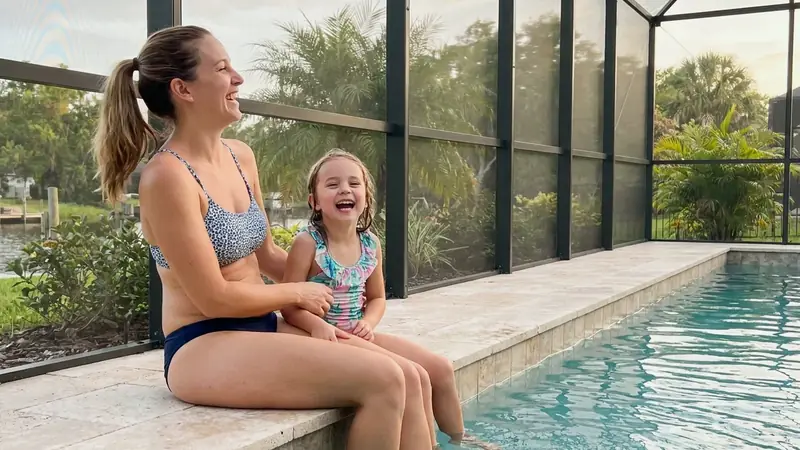
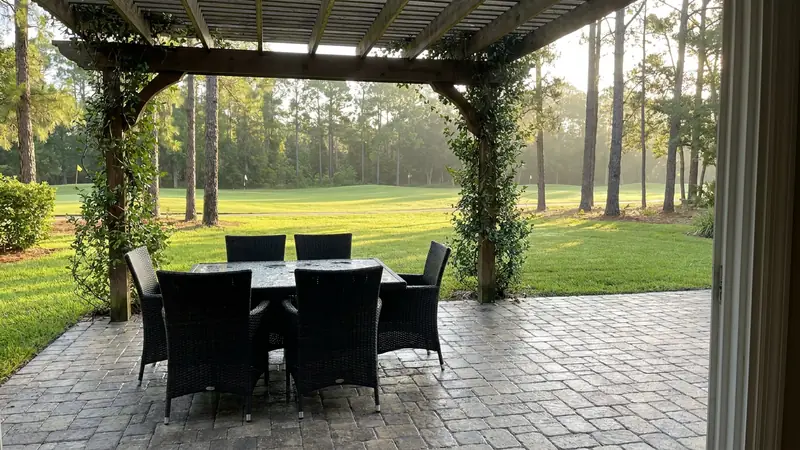
Which places near Baymeadows can ask about paver stain removal?
Baymeadows homes and each place below can ask for a free estimate. Every place has its own page with local notes. If your street is not named, call (904) 946-8454.
- Palm Valley
- Bartram Park
- San Pablo
- Ponte Vedra Beach
- Nocatee
- Sandalwood
- Beauclerc
- Jacksonville Beach
- San Jose
- Saint Johns
- Southside
- Fruit Cove
- Palencia
- Mandarin
- Atlantic Beach
- Arlington
- San Marco
- Fort Caroline
- World Golf Village
- Fleming Island
- Bellair-Meadowbrook Terrace
- Brentwood
- Argyle Forest
- Riverside
- Cedar Hills
- Lakeside
- Royal Terrace
- Paxon
- Panama Park
What do Baymeadows homeowners ask about paver stains?
How do I remove oil stains from brick pavers?
A contractor degreases and extracts, and repeats if needed. HydroSeal says oil needs that two-part approach and that deep absorption may remain. Hydro Wash 360 says brick and natural stone are more porous than concrete pavers, so ask how much of an old oil mark will lift before you agree.
What kind of paver sealer works in Florida?
Look for a formula that fits your paver material and your sun. Unilock says to check UV resistance for sunny parts of Florida. Sealing can also resist future stains, Unilock says, but only on a surface that is very clean and completely dry.
How much should I pay for paver sealing?
Jacksonville companies publish about $1.75 to $3.25 per square foot to clean, sand and seal. Hydro Wash 360 gives $1.25 to $3.25 for 2026 and says a bid under $1 usually means prep was skipped. Stain treatment is quoted apart.
Can I use Dawn dish soap to clean my pavers?
Unilock lists dish soap and warm water as the mildest first step for everyday dirt on concrete pavers. It does not clear rust, deep oil or mineral deposits, and Unilock says to test any product in a small spot. Travertine and other stone need stone-safe cleaners instead.
What causes orange stains on pavers in Baymeadows, and can they come out?
Safe Touch blames iron in well water and reclaimed irrigation. It says more pressure makes the stain worse and that it needs a rust treatment followed by a rinse. HydroSeal warns that acids used on rust can alter concrete and stone, so the product has to suit the paver.
Can leaf stains come out of pavers?
Many fade, though not all. Safe Touch says live oak tannin leaves brown water stains on Jacksonville walks and drives. HydroSeal says old tannin stains may not disappear completely, which is why a contractor should set expectations after a test spot.
Will bleach clear green growth from pavers?
Sometimes, but not on every surface. HydroSeal says diluted sodium hypochlorite can treat organic growth on many concrete pavers and is wrong for some stains, sealers, natural stone and plant areas. Unilock says never to mix bleach with vinegar or ammonia.
Does sealing keep stains from coming back?
It helps. Unilock says a quality sealer can resist future stains and make washing easier. Safe Touch says sealer on pavers keeps the next season from locking in tannin. A coat wears, so the protection fades as the sealer does.
Why do white spots keep returning on my pavers?
Efflorescence returns while water keeps moving through the paver, says Unilock, and poor drainage is a common reason. Rain alone will not clear it. The cause has to be found, or the white powder keeps coming back after each cleaning.
Is muriatic acid safe for cleaning pavers?
Unilock says to avoid it as a routine cleaner, because it can etch concrete pavers and change their color. It should be considered only with professional guidance for mineral deposits. A wire brush is also a poor choice, since it can leave metal bits that rust.
Should pavers be sealed after a stain is removed?
Often yes, once they are clean and dry. Paver Protections says a clean surface lets sealer bond, and skipping that step can cause early failure. Unilock says new efflorescence has to clear first, and suggests waiting 2 to 3 months before sealing.
What other paver jobs can I ask about in Baymeadows?
Marks on your pavers? Ask what will lift
Send a few photos with the short form or call, and a local contractor replies within 1 business day, often sooner.
Free, no obligation